

Alongside your excellent subject knowledge, your ability to deliver inspirational workshops with passion and your talent for organisation, there are a range of teaching skills that are invaluable as an education professional.
Teaching skills are often developed over time and gained with experience, but it’s important that as tutors, trainers and assessors, we actively work on developing teaching and training skills when planning our own professional development.
1. Reflective Practice
Reflective practice for trainers is an important process that many of us do informally after a delivering a training session, or spending time with our learners. To be truly effective, we should formalise the process by writing it down, this way we can look back to see where we’ve come from, or remind ourselves why we made the decisions that we have.
Reflective Practice is most effective when we follow a structure. One of our favourite methods is to review three things:
- What went well? If you are reflecting on a training session or assessment – What went well? What did your learners respond well to? What did you enjoy? What did you learn about yourself? What should you do more of?
- What could have gone better? Write down things that didn’t go as planned, that took longer than you expected or had an unexpected outcome. Consider how you could have changed your process and how this may have changed things.
- What next? What are you going to take forward from today? Are you going to change something in your delivery or approach?
We ask our trainee assessors, trainers and IQAs to reflect frequently as part of their learning journey. It is a powerful tool to help you discover a lot about yourself and how you will improve.

Other Models of Reflective Practice
Both Gibbs’ Reflective Cycle and The Driscoll Model provide useful prompts for you to use as an educator. The Driscoll Model is a simple but powerful method of reflecting, using just 3 simple prompts:
- What?
- So what?
- Now what?
You could use this in your reflective journal; using a statement such as
[Something] happened, the consequence was […] so now I will […]
For a more detailed reflection, Gibbs’ Reflective Cycles provides the following prompts:
- Description of the experience
- Feelings and thoughts about the experience
- Evaluation of the experience, both good and bad
- Analysis to make sense of the situation
- Conclusion about what you learned and what you could have done differently
- Action plan for how you would deal with similar situations in the future, or general changes you might find appropriate.
- (Source)
To find out more about how you use Reflective Practice to improve your professional practice, join us for an interactive workshop on 2nd November 2022 9.30-12.00pm (Select the Book Now at the bottom of this blog)
2. Questioning Skills
Questioning skills are so important for educators. We use them to find out how much someone knows at the start of the learning process; their motivations for learning with us; how well they are learning with us. How well we bond with our learners often depends on our questions – that is why it is so important to use open questions that challenge our learners to provide us with as much information as possible. We ask open questions rather that closed for example:
Instead of “Do you know how to edit that web-page?” you ask “so, explain to me how you edit that web page”
Whilst we are asking these questions that require more thought from our learners, we must learn to embrace the silence. Our learners’ brains will be processing what we have just asked them to do:
“They’ve asked me to explain how I edit the web page. Can I explain how to edit the web page? I know how to edit the web page. How do I put that into words. I hope I don’t get it wrong and look silly!”
So, while they are thinking, give them time. If they are looking lost then, prompt them…. but don’t tell them the answer…
Stretching your learners through questioning
Using Bloom’s Taxonomy of Learning, you can stretch and challenge your learners levels of understanding. The diagrams below show the different “levels” of learning and the questions you can ask to stretch them through those different levels.
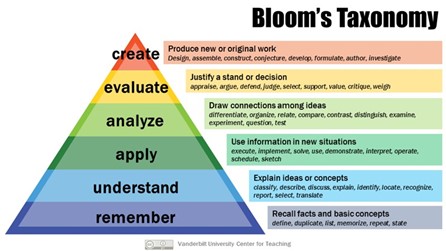
For example:
| Question relating to each level | |
| Creating Use information to create something new |
What will you change about this information when you pass it on to someone else? (Formulation of new ideas) |
| Evaluating Critically examine information and make judgements |
What is the most useful part of this information and why? Which part of this information will you use |
| Analysing Take information apart and examine relationships |
Do you need to use every bit of this information? |
| Applying Use information learned, in a new (but similar) situation |
When would you use this information? (Practical application of knowledge) |
| Understanding Demonstrate understanding of facts and ideas. Making sense out of information. |
How do you know that’s the answer? (Justifying your knowledge) |
| Remembering Memory of previously learned material by recalling fundamental facts, terms, basic concepts and answers about the topic. |
What is the answer? (Factual, either correct or incorrect) |
3. Giving Feedback for Development
The way in which learners receive feedback can have a huge impact on their overall learning experience. It’s not just about the content of the feedback, it’s about the context in which its received.
Also, it’s important to note that feedback is highly subjective and dependent upon the goals of the individual learner. In order words, negative feedback on a learner’s progression doesn’t hinder the learner if they’re disengaged or indifferent about their outcomes. At the same time, encouraging feedback is only valuable if the learner responds well to encouragement.
As an educator, you need to ensure that the way you communicate progress to your learners is tailored to the individual’s communication style, but delivered in such a way that helps them achieve their professional goals. Sound complicated? It doesn’t need to be!
It can be simply a matter of getting to know your learners, understanding their goals and keeping a record of it. Undertaking individual work-based assessments as soon as possible can give you a strong insight into each learner’s communication style.
Geoff Petty’s article on Medals and Missions, based on research by Professors Paul Black and Dylan Wiliam of Kings College London, refers to positive reinforcement as ‘medals’ – this is feedback that essentially tells the learner what they are doing well in relation to a particular goal/task/criteria. It’s more than an assessment mark or grade, it’s qualitative and provides commentary to the learner.
On the other hand ‘missions’ are areas where the learner needs to spend more time to improve in a certain area. Comments should be optimistic, positive and encouraging but informing the learner that they still have more work to do.
Examples of medals
- This is a well-written answer because…
- Your second paragraph shows a good level of understanding on…
- Well-made points here showing that you have considered…
Examples of missions
- You need to add more detail here about…
- Use more evidence to support your answer
- Expand on these points you’re making
These ‘missions’ advise the learner not only what they need to improve but also how they can improve. For example, the learner may need to write fuller sentences so you could give them a link to a credible website that could show them how to do this.
Most importantly, Petty advises that the mission must be linked to the original goal/task/criteria.
If you want to develop your Feedback skills, please join our online course: How to give feedback for development
Want more information?
*Please note, all our courses have a minimum number of 5 delegates to run