

If you’re new to teaching, training or assessment you may be wondering about the different types of assessment and when is the most appropriate time to use them.
In the second of this three part blog series, we explore Formative Assessment. You can read our Beginners Guide to Initial Assessment if you haven’t done so yet. A Guide to Summative Assessment will follow.
Why and When?
Formative Assessment, otherwise known as Assessment FOR Learning, happens throughout the learning journey. It prepares learners for their formal (or summative) assessment.
In post-16 education, we are usually working towards a set of qualification or industry standard. We usually have to tick a box to say the learner has sufficient knowledge, or skills to be competent at a task. This is Summative Assessment, or Assessment OF Learning.
So, why should we use formative assessment and how does it benefit both us and our learners?
It helps the practitioner establish where learners are with their learning, where they are going and what needs to be done to get them there (Ramaprasad, 1983). This process is not solely down to the practitioner, the learner should be involved in this process.
When done well, Formative Assessment enables learners to take responsibility for their learning, aids motivation and thereby increases learner achievement. Formative assessment activities can also be fun. You can introduce a bit of competition, hands on practical activities as well as questioning and discussion to keep your learners engaged, and use the outcomes of these activities to evaluate how they are progressing with their learning.
Formative assessment is an ongoing process that uses opportunities for questioning and discussion and feedback to ensure the learner is on the right path with their learning.
How?
As we have spoken about in our Planning Learning blog, it is important for our learners to be involved in the learning process from the outset. This enables them to take responsibility and to be motivated in their learning journey.
This means that our learners are clear on their learning goal – they know what they are working towards, this is reinforced with them at monthly visits, where targets towards achieving that goal are set. Those targets can be based on the outcomes of formative assessment.
If you are in a workshop environment, ensure your objectives are clearly stated at the start.
There are many different methods you can use to assess how well a learner is developing their skills and knowledge in a workshop or workbased environment. Here are a few that we use regularly in our practice:
Questioning
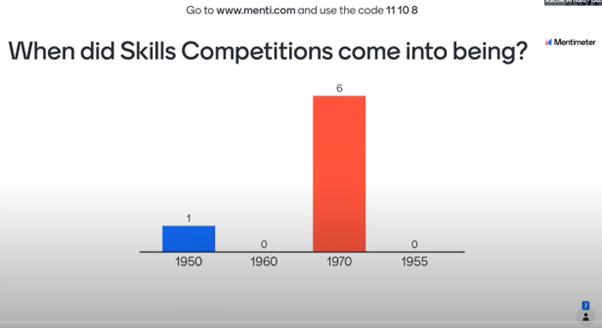
Questioning is such a powerful formative assessment tool. We just have to make sure we’re asking the right questions! Open questions such as “Why?” “How?” “Can you explain…” “Can you give an example of this in your workplace” can help us check our learner’s understanding. You could also use digital quiz tools such as Kahoot or Mentimeter (see below) which allow anonymity to prevent learners from feeling anxious when they don’t know an answer, or confidence to those who don’t like verbally answering questions in front of others.
Observation
In workplace environments observation of a task is an excellent formative assessment tool. Asking a learner to talk through what they’re doing as they are doing can also give useful insights into their understanding of a task. It’s also useful to observe your learner’s body language e.g. if they look confused or uncomfortable, as to whether they understand a topic or requirements.
Products of Work
Looking at work that a learner has completed can tell you a lot. Have they completed documentation correctly and in full? Have they included sufficient detail? You can use questioning to ask them why they think completing the documentation is required or important, who it needs to go to and how confidentiality of information is maintained.
Tools to Aid Discussion in Workshops
We are a big fan of using digital tools to aid learning, and there are some easy to use, free tools that are easily accessible, and you would have used most of them if you have attended our courses over the past few years. These tools are great for assessment for learning, by helping to aid discussion, giving learners the autonomy to answer questions and to be involved in the learning process.
Padlet – if in a workshop situation, learners can access a Padlet online and leave their comments to show their understanding of a topic. Facilitators can then take opportunities to expand dis

Credit: Rachel Arnold, Inspiring Skills Excellence.
Whiteboard – digital or physical
Whiteboards can be used to aid discussion – learners can record answers to questions, can categorise information,

Credit:Brian Todd, Siemens, https://www.excellencegateway.org.uk/content/etf2718

Credit, Ros Protheroe, Panda Education and Training Ltd
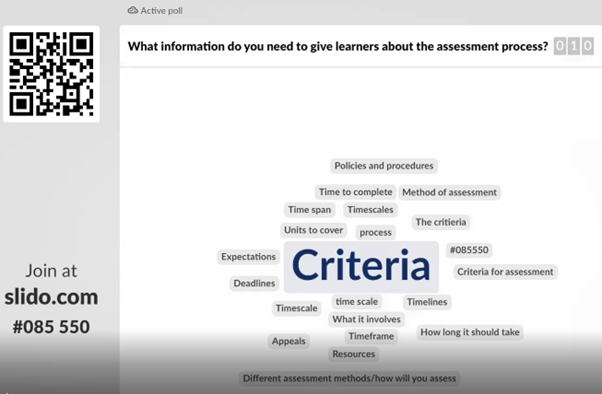
Word cloud
Word clouds allow learners to answer a question anonymously, it allows the tutor to identify answers and discuss these further with the group either confirming or expanding on knowledge
Quizzes
We have all used a Kahoot or even a Menti over the lockdown – using a quiz to assess for learning can add a bit of fun and competition into your sessions, (they’re also great for initial assessment at the start of a session)
Credit: Rachel Arnold, Inspiring Skills Excellence in Wales
Mindmapping –
This can help learners organise and categorise their information. You may ask them to do a mind map to prepare for a professional discussion, so that you can assess that they will cover all the main points that are required in the criteria.

Self Assessment – Reflective Practice
The learner must be clear about what they are assessing themselves against. They must have a clear understanding of the outcomes to say how well they think they know or can do an activity. They can say where they feel confident or where they may require more help.
Reflective practice – our learners can reflect after completing an activity, saying what they thought went well, what they could improve, and what they will then do to start making those improvements.
These methods empower the learner and make them feel in control of their learning.
Read more about The Importance of Self Reflection for Trainers and Coaches
Relationships and Rapport
It is very important that when using formative assessment methods, you have a good working relationship with your learner. They will feel more comfortable in opening up to you, more confident in answering (or not being able to) answer your questions; comfortable that it’s ok not to know and they are there on a learning journey with you.
This relationship is particularly important for giving feedback.
Giving Feedback for Development
You will want your learners to improve and succeed, which is why not all your feedback will be positive, it may be constructive and developmental, it must have a direction for the learner to follow once they have received the feedback.
Oral Feedback – This is where your feedback starts. Use a tone of voice that is calm and clear. Don’t patronise your learners. Keep your feedback task based and not personal. However, verbal feedback can be forgotten. You must ensure that your feedback is written down. This also provides an audit trail and is easier to reflect on to show progression. Our Feedback for Development online course can provide you with the knowledge and skills to be able to give great feedback!
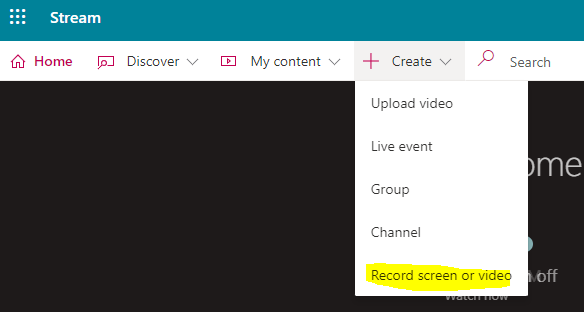
Screen Recording Feedback – Qualification Wales’ Review of Assessment Practice gives many great examples of post-16 tutors and assessors using technology for assessment for learning. Denys Bassett Jones, Digital Media Tutor at Pembrokeshire College, records his screen whilst commenting on learners work to allow specific feedback for development. This can be done using Microsoft Stream function on any computer with Office 365. Genius!
What next?
If you would like to learn more about giving feedback to learners, to help them develop their skills and knowledge as part of the Formative Assessment (Assessment for learning) process, you can complete our Assessor’s Toolkit: Giving Feedback for Development . Sign up for our newsletter to receive 10% discount.

References
Centre for Educational Research and Innovation https://www.oecd.org/site/educeri21st/40600533.pdf
Developing a Theory of Formative Assessment Black and William 2009 https://kclpure.kcl.ac.uk/portal/files/9119063/Black2009_Developing_the_theory_of_formative_assessment.pdf
Further Reading Assessment For Learning, Dr. Cheryl Jones https://dera.ioe.ac.uk/7800/1/AssessmentforLearning.pdf